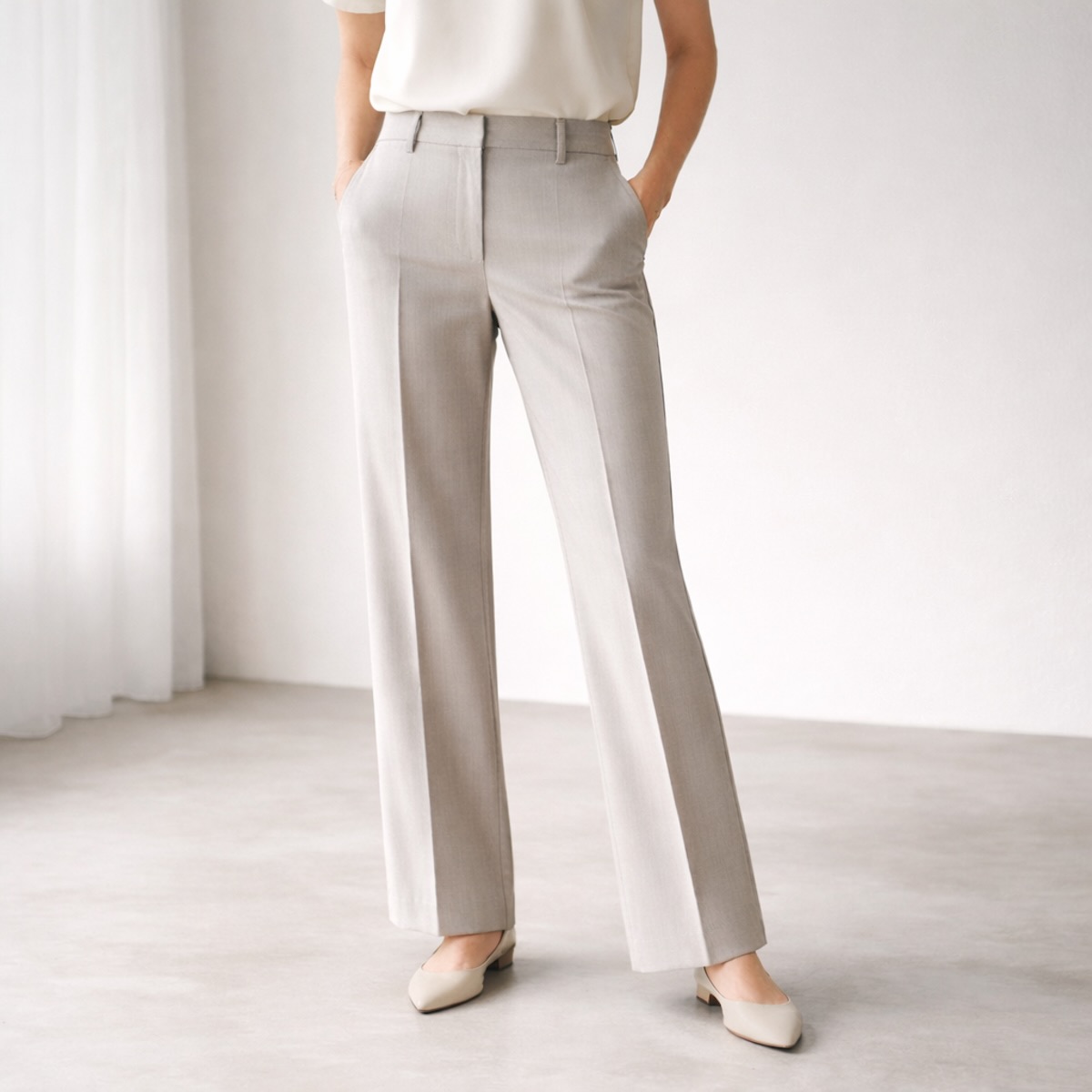
Most wardrobes accumulate more trousers than they use. Over time, the differences between them become minimal, and the value of having so many drops.
Trousers are tested across long days of sitting, walking, and movement. When they are of the right quality, the trousers in a wardrobe keep their shape, maintain proportion, and remain easy to reach for. When they are not, they stretch, collapse, or begin to feel wrong long before they are worn out.
A professional wardrobe works best with a small number of trousers, each serving a clear role.
How to Narrow the Field
Apply the same criteria every time, focusing on the signals that predict long-term performance rather than first impression.
We assess four things: whether the shape will still look right over time, whether the fabric will hold up to repeated wear, whether the piece solves a real need, and whether you will reach for it often without hesitation. In trousers, this is determined by fabric, construction, and overall shape, whether straight, wide leg, or relaxed.
Applied consistently, these four criteria narrow the field to a small number worth owning.
That smaller set is actually more complete. Each pair serves a clear role, and together they cover the full range of use without overlap. The set breaks down into three categories of trousers that will meet your needs, saving time and making getting dressed easier.
Each of the three categories below is adapted for climate through fabric choice. In warmer conditions, each role uses lighter weights, more open weaves, and breathable blends. The examples given here lean toward Spring and Summer, where high-twist wool remains one of the most breathable options.
The Daily Wool Trouser
This is the trouser worn through most of professional life: workdays, meetings, dinners, and long hours away from home. It needs to maintain the same clean line from morning to evening, without stretching, softening, or losing shape.
What matters most is the cloth itself. A strong trouser combines fabric quality and density. The weave and fiber determine how smooth and refined the surface looks. Density determines whether the shape holds or collapses. Both must be present.
When either is missing, failure shows quickly: bagging at the knees, distortion through the seat, and a crease that disappears mid-day.
The fabric should be wool-led, with enough structure to maintain a clean vertical line. Lighter weights can work in warmer conditions, but they must still retain density relative to their weight. Softness without structure does not hold. Weight without refinement feels heavy and dull.
The cut should support the same clarity. A mid- to high-rise, a clean waistband, and a straight or slightly wide leg allow the trouser to work well across settings. Pleats are optional and should support shape, not add volume.
The goal is a consistent appearance throughout the day.
When this category is right, it becomes the foundation of your wardrobe.
Use
- Worn for: workdays, meetings, professional dinners, evening plans
- Worn with: tailored blazers, structured coats, refined knitwear, loafers, slingbacks, low heels
- Feels: precise, composed, controlled
Investment Examples
Loro Piana Kendrik Wool Pants – structured wool that holds a stable look throughout the day
The Row Virgil Wool Gabardine Pants – compact gabardine that resists wrinkling and maintains shape
Max Mara Wide Trousers in Wool and Silk Poplin – wool-led fabric that holds a clean line, with silk adding refinement without softening structure
The Transitional Trouser
This is the most adaptable trouser in the wardrobe. It moves across settings, handles long days, and continues to look right throughout the day.
The difference shows in the cut and fabric. There is slight ease through the hip and thigh, allowing movement without pulling or distortion. The fabric holds a line, but without the rigidity of a formal trouser.
Lighter or more open weaves are common materials here. Small amounts of synthetic fiber may be used to improve recovery and mobility. In some cases, engineered fabrics perform this role more reliably, especially when wrinkle resistance and shape retention matter across long days.
Construction reflects use. Unlined interiors, subtle waistband flexibility, and cuts that allow easy sitting and walking signal a piece built for wear, not just appearance.
When this category is right, it handles the widest range of daily use.
Use
- Worn for: mixed activity days, movement, travel, shifting settings
- Worn with: knitwear, lighter jackets, unstructured outerwear; flats, loafers, low heels
- Feels: composed but not formal; put together without looking dressed
Investment Examples
Joseph Trina Light Wool Tailoring Trousers – lightweight, straight-leg pant with slight room through the hip and thigh that keeps a clean line without stiffness
Loro Piana Hector Pants – lightweight wool, silk, and linen blend with ease through the leg that holds its shape while allowing movement and airflow
Brunello Cucinelli Wool Baggy Sartorial Trousers – tropical wool construction with fuller volume allows airflow and movement while keeping the leg line defined
M.M. LaFleur Rina Sculptural Pant – engineered OrigamiTech fabric maintains a consistent, polished appearance through extended wear and travel, while the slightly wider leg introduces ease without sacrificing overall structure
The Casual Trouser
This is where the wardrobe relaxes without lowering its standard. The line of this trouser softens, but remains defined.
The distinction shows in the cut and fabric. The silhouette allows more space through the leg, often wider or slightly cropped, with less emphasis on a sharp crease. The fabric shifts to cotton, linen, or softer wool blends that favor comfort and breathability, while still holding enough weight to look structured through wear.
Construction is simpler, but still controlled. Clean waistbands, balanced proportions, and stable drape keep the trouser composed, even as the fit feels more relaxed.
When this category is right, it feels easy, but not careless.
Ease can come through waistband, cut, or overall shape, but the result stays the same: relaxed, with a clean line. Linen qualifies here only when weight and construction maintain shape. Otherwise, it falls outside the investment standard.
Use
- Worn for: off-duty, errands, travel days, informal meetings
- Worn with: knitwear, relaxed shirting, relaxed tailoring, lighter outerwear, flats, loafers, minimal sandals
- Feels: relaxed, but still considered
The ideal version of this category, one that combines strong material with a stable, full-length silhouette, is not widely available. Most options involve trade-offs between fabric, shape, and refinement.
All selections below meet the standard for long-term wear. The difference is in how they balance structure, softness, and ease. Some maintain a sharper line through extended wear, while others soften slightly as part of a more relaxed silhouette. Higher pricing is justified only when the improvement in performance meaningfully affects daily use.
Investment Examples
WARDROBE.NYC Drill Cotton Trouser – heavy drill cotton with a more architectural silhouette that maintains a strong, controlled structure throughout the day
Toteme Relaxed Chino Trousers – softer organic cotton twill with a relaxed drape that prioritizes ease over sharper structure
Joseph Jaber Cotton Blend Straight-Leg Pants – full-length straight trouser that balances a polished line with the comfort of a softer cotton blend
Marella Cotton Gabardine Trousers – lightweight cotton gabardine that prioritizes wrinkle resistance and ease through regular wear
Everlane Cotton Twill Chino – dense cotton twill with a structured shape that maintains a polished appearance despite the more casual cropped length
A well-built wardrobe relies on clarity, not variety. Each trouser serves a distinct role, and when chosen correctly, those roles cover the full range of daily use without overlap.
In practice, this does not mean owning only one of each. These are high-frequency pieces, worn across full days and repeated weeks, so each category requires enough rotation to move through wear and laundering without gaps. For most professional wardrobes, two to three pairs in the highest-use categories is usually enough. The goal is the right number of the right trousers, not fewer trousers at all costs.
The result is a system that holds its standard day after day, with less effort, fewer decisions, and no dependence on excess.