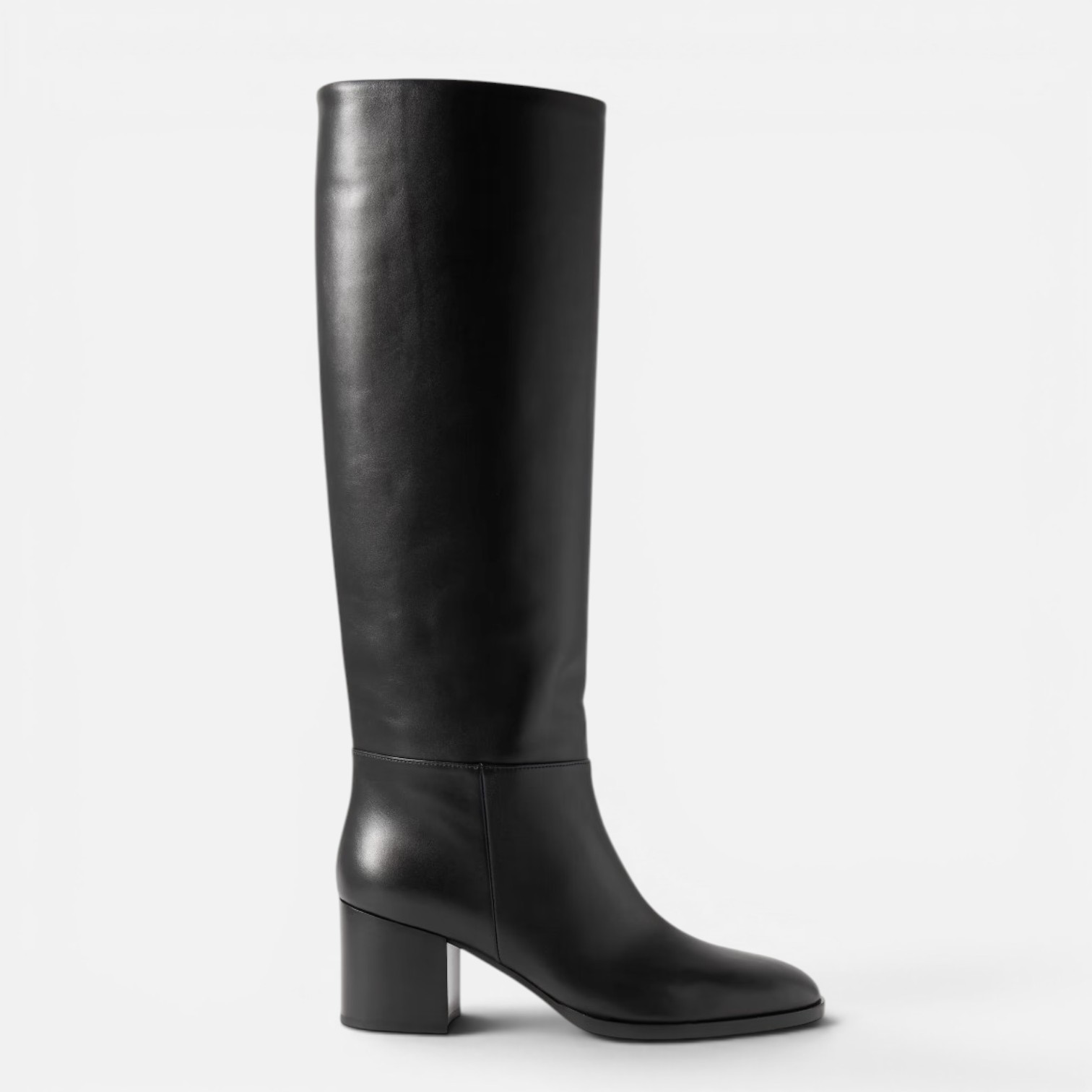
Knee-high boots are easy to get wrong because they photograph better than they wear. On a screen, almost any tall boot looks great. In real life, most of them sag at the ankle by the second season, pull at the calf, or read as a trend the moment the trend passes. Knowing how to choose knee-high boots that last is what separates the pair you reach for all winter from the pair that sits in the box.
The market is full of well-made leather boots, and also full of two traps worth naming. The first is the fashion boot: a faux-leather upper, a stiff synthetic shaft, and a novelty heel, built to look current for one season and to be replaced the next. The second is the shapeless slouch boot, all excess leather and no structure, which looks relaxed in a photograph and formless the moment you stand up in it. A professional wardrobe needs neither. It needs one or two tall boots with real leather, a clean line, and enough structure to hold their shape through a full winter, and plenty of good boots deliver exactly that. The rest of this guide is about telling them apart.
What A Knee-High Leather Boot Does
A knee-high boot is a winter workhorse. It expands what the rest of the cold-weather wardrobe can do.
With a skirt or a dress, it adds warmth without sacrificing polish. It slips under tailored trousers without adding bulk and makes denim look more finished. It is the piece that lets a professional wardrobe move into fall and winter while preserving a clean silhouette.
A good pair carries the coldest four or five months of the year, which is exactly why it deserves careful consideration before you buy.
How To Choose Knee-High Boots That Are Worth Buying
A knee-high boot is worth buying when the leather, the shaft, and the sole are all built to last, and the fit is right for your leg.
Ideally, look for full-grain leather. It retains the hide’s dense outer layer, which can improve resistance to wear and allows the surface to be conditioned and polished as it ages. When minimally coated, it can soften and develop a patina rather than depending on a heavy finish to remain presentable. However, leather descriptions are often incomplete. “Calf leather” identifies the hide but not its grade or finish. When examining a boot in person, favor leather that feels supple rather than heavily coated and flexes without the finish separating or forming sharp, pale creases. Credence identifies leather as full-grain only when the brand confirms it.
The shaft is where many tall boots quietly fail. The shaft should maintain a reasonably clean line from ankle to knee. Some creasing at the ankle is inevitable, but excessive pooling usually indicates leather that is too soft or a shaft that fits poorly.A shaft with no structure slouches, and a shaft that is too stiff cuts and creaks. The calf circumference has to suit your leg. Too tight and the boot pinches and is a struggle to pull on. Too wide and it gapes at the top, making the boot look poorly fitted. Either way, it goes unworn.
The sole and heel construction strongly influence how well a boot will age. Look for a substantial leather or high-quality rubber outsole, securely attached without gaps, and ask whether the sole and heel lifts can be replaced when worn. The heel should sit level, feel stable underfoot, and show no movement where it joins the boot. Construction methods vary, so judge the quality of the assembly rather than assuming that one type of heel or sole is always superior.
The hardware matters too. A smooth, sturdy zipper with a leather backing lasts, while a flimsy exposed zip can be the first thing to break.
A good knee-high boot should look right with plain trousers and a knit now and three winters from now.
You do not need all of these. A tall boot can play more than one role, so pick the one or two that suit how you dress. Most professional wardrobes are covered by a single core boot, with a second added only if it fills a clearly different wardrobe need.
The Core Black Leather Boot
The core black boot is the one that does the most work. Black leather in a clean, structured shaft goes with skirts, dresses, tailored trousers, and denim, and it reads as professional in almost any setting. This is the pair to buy first, because it solves the widest range of winter dressing problems. Look for full-grain leather, a shaft that holds its shape, a comfortable low-to-mid heel, and construction that a cobbler can resole.
Examples Worth Considering
Gianvito Rossi Santiago 60 – smooth calf leather offers excellent durability and easy polishing. The round toe and stable 60 mm block heel feel classic and authoritative, making this the strongest all-day option, although the pull-on shaft is less adjustable.
Khaite Sybil 40 – vegetable-tanned glossed calf leather is durable and develops a natural patina, though scuffs may show and require occasional polishing. Its pointed toe and sculptural 40 mm heel give it the most directional, fashion-conscious character.
Jil Sander Knee Boot – smooth calf leather with a nappa lining provides refined durability, while the leather sole benefits from protection. Austere and architectural, its low heel is highly wearable, but the narrow pull-on shaft is the least accommodating.
Aeyde Sabrina 35 – smooth calfskin is durable yet supple, though the pointed toe and kitten-heel tip require care. Sleek and feminine, its 35 mm heel and inner zipper make it more accessible than the similarly minimalist Jil Sander.
Le Monde Béryl Allegra – smooth black leather and a cushioned calf-leather insole balance longevity with comfort. The almond toe and 25 mm heel create a quieter, equestrian character that is less formal but more relaxed and walkable than the pointed styles.
The Brown or Tan Boot
The brown boot is the softer neutral for days when black feels too sharp. Mid-brown, cognac, or tan leather warms up cream, camel, gray, and denim and suits a wardrobe built on softer tones. In these shades, the finish is part of the appeal, so look for supple, well-finished leather that will soften and gain character with wear.
Examples Worth Considering
Gianvito Rossi Santiago 60 in Brown Calf – smooth calf leather, a round toe, and stable 60 mm heel make this the most polished, traditional office option.
Gianvito Rossi Joyce 55 in Brown – smooth calf leather and a streamlined shaft give this boot a polished, dressier character. The pointed toe and 55 mm flared kitten heel are elegant without feeling severe, although the slim heel is less practical on wet or uneven ground.
Zimmermann Eddie 70 – pecan-brown leather gives this boot a warm, polished finish. Its round toe, subtle scalloping, and 70 mm block heel feel feminine and refined. The side zipper is convenient, but the higher heel is less practical for extended walking.
Gabriela Hearst Marion – smooth leather, a rubber sole, and a 55 mm stacked heel make this one of the more practical options. Cognac leather and subtle Western piping give it a warmer, more relaxed character.
DuoBoots Haltham in Brown Leather – smooth calf leather, an anti-slip sole, and memory-foam cushioning make this the most practical option. Multiple calf widths and three shaft heights accommodate a much broader range of leg shapes.
Match The Heel And Weather Protection To Your Routines
Heel height and weather resistance should reflect where and how you will wear the boot. A low heel can suit more formal offices, while a flat sole is usually better for commuting, travel, and long periods of walking. If rain, snow, or road salt is common where you live, prioritize a weather-resistant upper and a rubber outsole. For an active routine, a flat, weather-resistant black boot will often be the most useful version of the core style.
Unless a boot already has a protective rubber outsole, many leather-soled styles can benefit from a cobbler-applied thin rubber half-sole. Pointed toes may also benefit from recessed toe taps, while slim heels should have their heel tips checked and replaced before they wear through. Many leather uppers can be made more water-resistant, but treatment must suit the specific leather and finish. Follow the manufacturer’s care guidance and consult a reputable cobbler before altering designer boots.
Boots Most Professional Wardrobes Don’t Need
Some tall boots add choice without adding use.
- The trend boot. It dates fast. A novelty heel, an unusual toe, a hardware-heavy shaft, or a color of the season may look current now and wrong within a year. The more recognizable the design, the fewer quiet uses it has.
- The slouch boot with no structure. It rarely reads as professional.
- The thin fashion boot. A faux-leather upper and a glued sole feel like a bargain and actually cost the most, because you rebuy them every winter.
- A second or third black boot. If it does almost the same job as the first, it is not worth owning. A different heel or a small detail is not reason enough to own it.
- A third color. Having another color you love is appealing. Just know it takes away from the amount of wear the other two get and means more decisions when getting dressed.
How To Choose Between Them
The first boot you should own depends on the gap that shows up most.
If you dress mostly in tailored, darker outfits, start with the core black boot. It carries the widest range of professional winter looks. If your wardrobe leans on cream, camel, and softer tones, add the brown boot as your second, because it warms those outfits in a way black cannot. And whichever you buy first, match the heel height and weather protection to your daily routine: a low heel for dressier rooms, a flat weatherproof pair if you travel, walk, or face real weather.
Buying out of order is how a closet fills with tall boots that overlap. The right boot answers a clear need rather than repeating one you have already solved.
How Credence Evaluates Boots
Credence evaluates a boot by how it wears rather than how it photographs. It is the same standard Credence applies to every piece: Does the design last? Does the material hold? Does it do its job? Is it worth the cost per wear? A boot has to pass all four before it is recommended here.
In practice that means checking the leather by hand, reading the shaft and the calf fit on the leg, turning the boot over to see whether it can be resoled, and testing the zipper and the heel. The pairs above are candidates worth evaluating on those terms, and each one still has to pass in person before it earns a Credence verdict and a cost-per-wear figure in the buying guide. Price comes after those standards. A boot is worth more when the quality is clear, it fills a clear wardrobe need, and it is likely to be worn through many winters.
The Right Boot Makes More Outfits Work
Formality alone does not determine whether a tall boot is useful. The better question is whether it makes more of your winter wardrobe wearable by adding warmth to skirts and dresses, sitting neatly beneath trousers, and giving denim a more polished finish.
The best knee-high boots make more outfits work, hold their shape for years, and still look right long after the season you bought them.