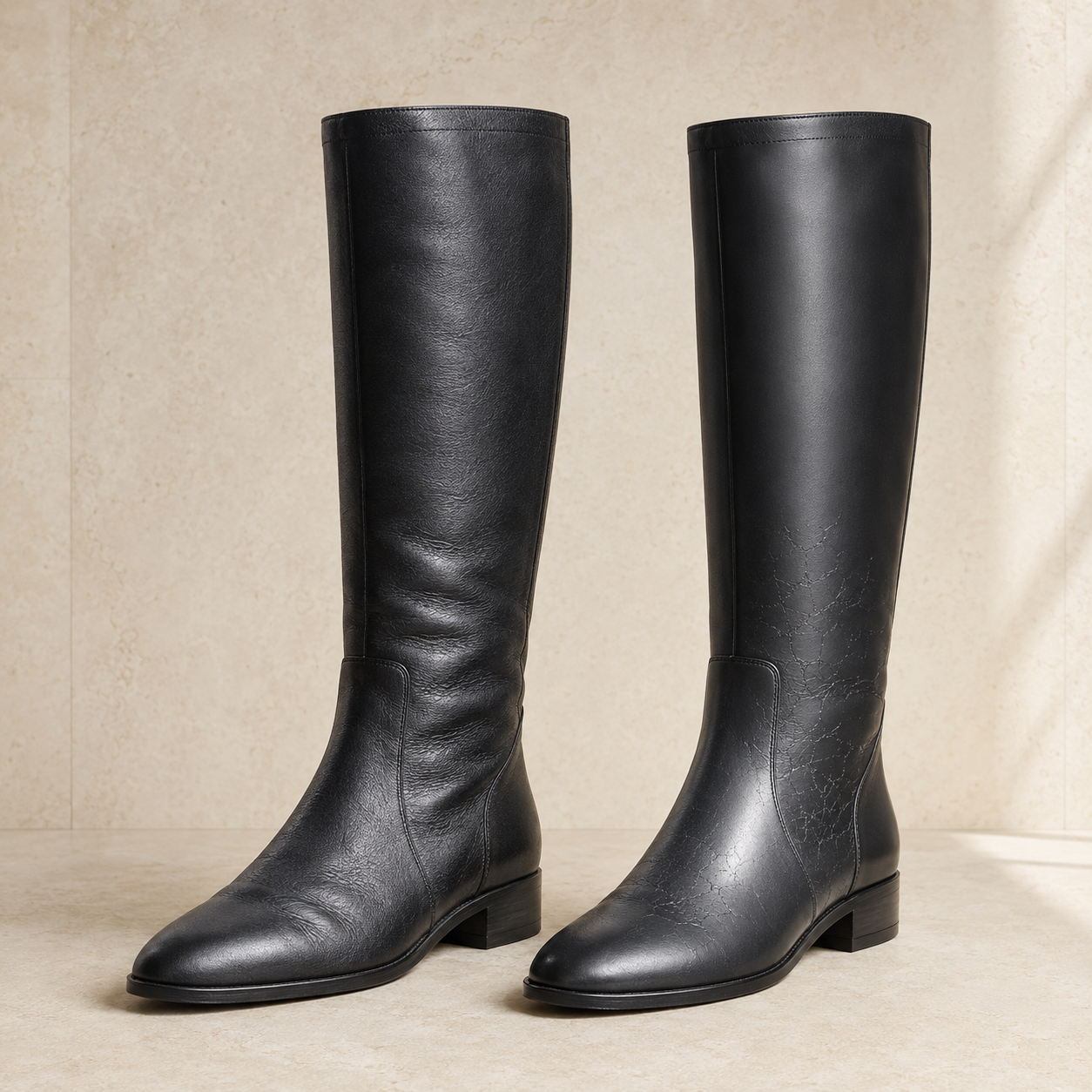
Once a woman confirms that a boot is made from leather, she usually stops asking about the material, so full grain vs genuine leather rarely enters the decision. Her attention moves to the heel, toe shape, and whether the shaft fits. That is where money is often lost and frustration begins. After a season, the difference shows. A full-grain boot will have softened and developed natural creases. The other will have cracked despite carrying the same “real leather” label. The leather grade is why. At Credence, a boot we’d buy has to meet the Standard, which always includes material quality.
The “Genuine Leather” Trap: Is Genuine Leather Good?
Is genuine leather good? “Genuine leather” is not a quality grade at all. The phrase simply confirms that the material came from an animal hide. That is all it confirms. A boot bearing the label may still be made from a weaker inner layer of the hide or from leather whose natural surface has been sanded away and coated. If the brand gives no more detail, you cannot tell how well it will wear.
Full Grain vs Genuine Leather: The Grade Ladder
Leather labels are often shown as a tidy five-step ladder, although the names describe different things. Some identify the layer of hide used. Others describe what was done to its surface. For boots, the useful question is how much of the strong outer layer remains.
- Full-grain leather: The natural outer surface remains unsanded. It creases and softens with wear, can develop a patina, and may last for years in a well-made boot.
- Top-grain leather: The stronger outer layer is lightly sanded and finished for a more even appearance. It remains a good choice when little of the surface has been removed.
The practical dividing line is here. Below it, the original surface has been heavily altered or removed.
- Corrected-grain leather: The surface is sanded, pressed with a new grain pattern, and sealed beneath pigment or polyurethane. A heavy coating can split at the vamp or ankle.
- “Genuine leather”: The words confirm only that the material contains leather. The boot may be corrected-grain or split, so you still do not know how it will wear.
- Split leather: This comes from the lower layer of the hide after the stronger outer layer has been removed. It is weaker and handles repeated bending less well.
- Bonded leather: Scraps and leather fibers are glued into a sheet. It can peel apart much like a fused blazer bubbles when its adhesive fails.
Why Do Leather Boots Crack Even When They Are Real Leather?
Every step forces a boot to bend across the vamp and ankle. Sitting does the same. On corrected leather, these areas may sit beneath heavy pigment or a polyurethane coating. If that layer cannot stretch with the leather, fine pale lines appear. They deepen until the surface splits or starts to lift.
Full-grain leather keeps its natural surface intact so normal bending leaves creases, but in leather which can handle the movement better. With wear, the leather softens around them and often deepens in color.
Any leather can crack if it becomes very dry, is repeatedly soaked, or is exposed to salt, but a surface that cracks or peels after one season of ordinary wear has failed early.
How to Tell the Grade
If you are trying to find out if leather is good quality, start with the product description. If that doesn’t tell you the specific leather layer outlined above, the answer is often found by messaging customer service via the site’s chat. After that, handling the boot can give some clues.
- Read the description. Remember that “Genuine leather” and “leather upper” confirm only that some form of leather was used. “Calf leather” identifies the type of hide. It does not identify the grade. If you don’t find full-grain, top-grain, corrected-grain, split leather, or bonded leather in the description ask customer service.
- Feel the surface. In person, full-grain leather often has some give and small changes in texture. A grain pattern that repeats exactly or a plastic-like surface can point to embossing or a heavy coating. Very smooth calf can still be excellent.
- Press the vamp lightly. Press lightly at the vamp. The leather should give without forming a sharp pale line or separating at the surface. Folding the boot can create the damage you are trying to detect will happen.
- Ask if the sole can be replaced. A clear repair policy is more useful than visible stitching alone. If the outsole can be removed without damaging the upper, the boot was built for longer use. This supports the overall quality of the boot, although it does not reveal the leather grade.
- Inspect a cut edge. Check near the top of the shaft, zipper, or tongue. Leather should look fibrous through its thickness. A fabric backing, foam layer, or crumbly center can indicate synthetic or bonded material. Painted and folded edges may hide this.
A Quick Word on Tannage
Tannage turns a hide into leather. Vegetable tanning usually produces firmer leather that holds its shape and darkens with age. Chrome tanning gives more softness and flexibility, which suits a fitted boot shaft.
For durability, grade comes first. A full-grain chrome-tanned boot can outwear one made from corrected vegetable-tanned leather. Tannage also affects how readily the leather takes conditioner, recoloring, or reshaping. Replacing a sole or rebuilding a heel depends on how the boot was constructed.
What This Means When You Buy Boots
The Standard asks one direct quality question: Is it well made? In a boot, the answer shows at the vamp and ankle, where the leather bends again and again. If the surface cracks, lifts, or peels under normal wear, the style and brand cannot make up for it.
After the leather passes those checks, choose the heel height and toe shape around your clothes and how far you need to walk.
Use The Only Knee-High Boots Worth Buying for a Professional Wardrobe to judge shaft fit, calf width, soles, and weather protection. You will also find specific boot recommendations there. The Only Shoes Worth Buying for a Professional Wardrobe helps place the boot within the rest of a professional shoe wardrobe.
Common Questions
Is genuine leather good quality?
Not usually. “Genuine leather” sounds like a promise, but it is one of the lower grades. It means the hide has been sanded down and sealed under a coating, which is why it cracks at the flex points within a year or two. The word tells you the piece is real leather. It says nothing good about how it will wear.
What is the difference between full-grain and genuine leather?
Full-grain is the top surface of the hide, left intact, so it breathes and softens and ages well. Genuine leather is a lower layer with a fake grain pressed on and a finish sprayed over it. One improves with use. The other wears out.
Why do leather boots crack?
It’s almost always the coating. Corrected and genuine leather carry a heavy finish, and that finish splits where the boot bends at the ankle and the toe. Full-grain creases in the same spot and keeps going. If a real-leather boot cracked in a season, the grade was the problem.